
Learn to Surf: 10 Helpful Tips for Getting Started
Updated for 2026
Learning to surf is both challenging and rewarding. It takes time to become comfortable with the board, the waves and the changing conditions in the ocean. I’ve been surfing since the early 1970s, and through our NSSIA Accredited Surf School we have helped thousands of people take their first steps into surfing.Wherever you are learning, suitable waves, the right board and a few basic skills will give you a much better start.
These 10 tips cover the main things you need to get started—from choosing a suitable beach and learning to paddle and stand, through to whitewater safety, surf etiquette and catching your first green waves.
10 Tips for Learning to Surf
Here is a quick checklist. Each point is explained in more detail further down the page.
- Start in small, crumbly whitewater waves.
- Use a bigger, stable surfboard while you are learning.
- Watch the waves before paddling out.
- Learn where to lie on the board.
- Practise your pop-up on land first.
- Keep your board beside you, not between you and the waves.
- Learn basic surf etiquette before going out the back.
- Build confidence in the whitewater before moving to green waves.
- Surf often enough to build paddle fitness.
- If possible, have a lesson with an experienced surf instructor who takes the time to explain each step.
A Guide to Learning to Surf
The tips above are a starting point. Below I’ll explain each one in more detail and help you understand what to expect while you are learning.

Learning to Surf Is Addictive
“It’s like the mafia. Once you’re in, you’re in. There’s no getting out.” – Kelly Slater
Surfing is one of those things that is hard to explain until you have actually felt it.You are in the ocean, learning to work with something that is always moving and changing. No two waves are quite the same.
After more than 50 years of paddling out, I still never get bored with it. I am still learning, and I still get that same feeling when a wave lines up properly.
A lot of surfers call that feeling stoke. It means the excitement, frustration, addiction and pure fun of surfing all rolled into one.
When you are learning, it helps to practise the basics on the beach before going into the water. Start in suitable waves and give yourself time. Confidence and timing develop naturally as you become more familiar with the board and the ocean.
Where to Learn to Surf
Start with small, slow whitewater waves
The most suitable place to learn is not usually the most powerful wave on the beach. Small waves that have already broken and are rolling gently towards the sand give you time to become comfortable with the board and practise standing up.
Look for a sandy beach, soft whitewater waves and plenty of open space. You will probably walk your board back out many times, and this gives you the chance to catch plenty of waves without using all your energy paddling.
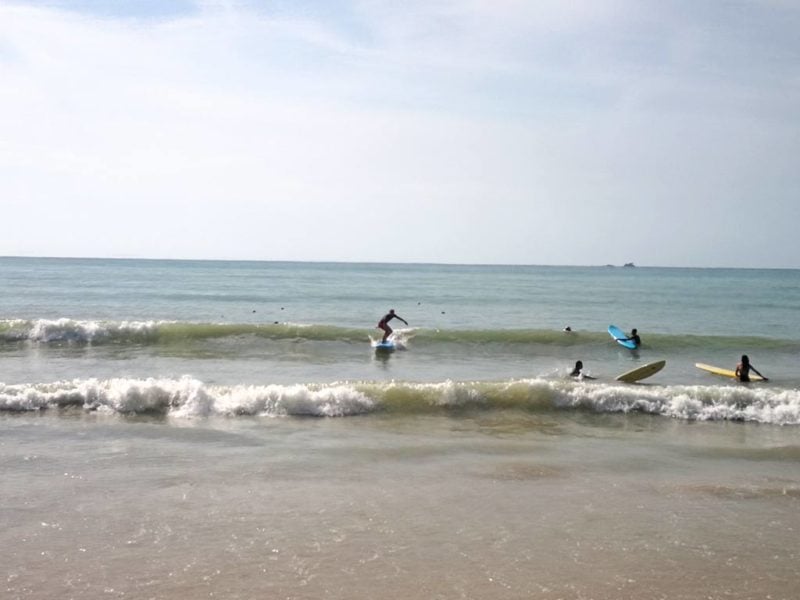
If the waves are breaking hard, pushing you around or breaking a long way from shore, look for a smaller and more sheltered area. Gentle whitewater will allow you to practise safely and catch more waves.
It is also best to avoid a crowded surf break while you are learning to control your board. Choose an area with plenty of room, while still staying near enough to other people to get help if you need it.
Before you go in, stand on the beach for a few minutes and watch the waves. See where they are breaking, where people are sitting, where the bigger sets come through and whether there are rocks, rips or other hazards. This will help you choose a safer place to enter and leave the water.
A surf school can also give you an idea of which part of the beach is suitable. Lessons are normally held where the waves and water depth are best suited to learning.
Read the full guide to choosing the right beginner surf spot
Choosing Your First Surfboard
A bigger, wider board will make learning easier
Your first surfboard should give you plenty of opportunities to catch waves and practise standing up. A high-performance shortboard requires more paddling strength, balance and precise positioning, so it is rarely a suitable board to learn on.
For learning to surf, you want a board with plenty of float, stability and glide. Bigger boards are easier to paddle, easier to catch waves on, and more forgiving when your pop-up is still developing.

A suitable board for learning is usually a soft-top, minimal, mini-mal, funboard or wider hybrid shape. Look for something wide, thick, stable and long enough to paddle easily. Many people start on a board around 7′ to 8′ long, although the right size will depend on your height, weight and the waves you will be surfing.
- Soft-tops are forgiving, stable and good for first lessons.
- Minimals and mini-mals paddle well and catch waves easily.
- Funboards and hybrids can be good once you have some balance and confidence.
- Shortboards are more difficult to paddle and balance on, so they are better left until you have developed the basic skills.
- Rent or borrow first if you can, so you can try a few boards before buying one.
There is no need to move to a smaller board quickly. Time spent on a bigger board allows you to catch more waves and develop your balance, turns and board control. When those skills become comfortable, you may be ready to try something shorter or more performance based.
Read the full guide to choosing the right beginner surfboard
Watch the Surf Before You Paddle Out
A few minutes watching can save you a lot of trouble
Take a little time to get a feel for the conditions before paddling out. Surf changes all the time, and conditions can feel quite different once you are standing in the shorebreak with a board under your arm.
Before you go in, sit and watch the surf for a few minutes. Look at where the waves are breaking, where the bigger set waves come through, where other surfers are sitting, and where the water looks calmer. You are trying to work out where to paddle out, where to catch waves, and where you can come back in safely.

Also look for rips, rocks, shallow sandbanks, swimmers and other surfers. If you are unsure about the conditions, ask a lifeguard or an experienced local surfer before going in.
You can also use this time to loosen your shoulders, back and legs, put on sunscreen, wax your board and make sure you feel ready before paddling out.
Read the full guide to what to do before you paddle out
Where to Lie on Your Surfboard
A balanced position helps the board move smoothly
Before working on your paddling technique, take some time to find the right position on your surfboard. If you are too far back, the board will drag through the water. If you are too far forward, the nose may catch under the water.
As a rough guide, the nose of your surfboard should sit just above the water when you are paddling. On most boards used for learning, that usually means lying around the middle of the board with your body straight, chest slightly lifted and your weight balanced.
You should be able to paddle without the board wobbling all over the place. If the board keeps turning sideways, sinking at the nose, or dragging at the tail, move your body slightly forward, or back until it feels smoother and more balanced.
Small adjustments can make a noticeable difference. Once you find a balanced position, paddling, catching waves and standing up will all feel easier.
Read the full guide to where to lie on your surfboard
How to Paddle a Surfboard
Good technique helps you paddle with less effort
Paddling is one of the most important skills in surfing. It is how you get out through the waves, move around in the water and catch waves. It takes time to build paddling strength, so it is normal to tire quite quickly at first.
Good paddling is not only about paddling as hard as you can. Aim for long, smooth strokes close to the surfboard, with your body balanced and your chest lifted slightly off the board.
Keep your head and body straight, relax your arms and bring each stroke smoothly through the water. A smooth, steady rhythm will help you conserve energy.
A bigger surfboard will usually paddle better because it has more float and glide. That is one reason learning on a suitable board makes such a difference.
- Keep your body straight and balanced on the board.
- Use long, smooth strokes close to the rails.
- Keep your fingers relaxed, not stiff and tense.
- Lift your chest slightly so the board trims properly.
- Paddle efficiently, not just as fast as possible.
The basic paddling stroke is easy to understand, but it takes practice to get good at it. Over time, better paddling means you waste less energy and catch more waves.
Read the full guide to paddling a surfboard properly
Goofy or Regular: Which Foot Goes Forward?
Work out your stance before practising your pop-up
Before you start practising your pop-up, you need to know whether you are regular foot or goofy foot. This simply means which foot you naturally put at the front of the surfboard.
Regular foot means your left foot goes at the front of the board.
Goofy foot means your right foot goes at the front of the board.

Most people work this out naturally once they start practising. One stance will usually feel more comfortable than the other.
A few simple ways to test your stance:
- The slide test: slide across a smooth floor in socks. The foot that goes forward is usually your front foot.
- The gentle push test: have someone give you a light push from behind. The foot you step forward with is usually your front foot.
- The stair test: notice which foot you naturally lead with when going down stairs, your front foot.
- The skateboard test: ride a skateboard if you can. Your front foot on a skateboard is usually your front foot when surfing.
Choose the stance that feels natural and practise your pop-up that way each time. Repeating the same movement will help it become familiar.
Next step: learn how to pop up on a surfboard
How to Pop Up on a Surfboard
Practise it on land before trying it in the water
The pop-up is the movement from lying down to standing in your surfing stance. It is an important skill and is much easier to practise on the beach before trying it on a moving wave.
Start slowly and concentrate on making one smooth, controlled movement. Bring both feet underneath you, keep your knees bent and your body low, and look forward.
- Lie on the sand with your hands beside your ribs, close to your body.
- Push your chest up using your hands, not your elbows or forearms.
- Bring your back foot underneath you first.
- Place your front foot between your hands, pointing across the board.
- Stay low, bend your knees, take your hands off the board, and look where you want to go.
- All of these steps should be done in one smooth body movement
Try to move directly to your feet rather than stopping on your knees. It may take some time, but practising the complete movement on land will help it become more natural in the water.
Also remember to rotate your hips. If both feet land facing forward like you are on snow skis, you will have very little balance on a moving surfboard. Your feet should be across the board, with your body turned slightly sideways.
Remember to look forward rather than down at the board. Your body tends to follow where you are looking, and looking ahead will help your balance.
Read the full guide to popping up on a surfboard properly
How to Fall Off a Surfboard Safely
Falling is a normal part of learning to surf
Do not be discouraged when you fall off your surfboard. Everyone falls off, even the best surfers in the world fall off sometimes. The important thing is learning how to fall without landing on your board, diving into shallow water, or coming up too quickly with your board still flying around.
In small, gentle waves, falling off is usually not too dramatic, but it is still worth learning how to fall safely. Be aware of shallow sandbanks, other surfers, your board and its fins.
- Surf within your ability and do not paddle out in waves that are too big for you.
- Try to fall away from your surfboard, not directly onto it.
- Do not jump or dive off your board, especially in shallow water.
- Cover your head with your arms when you are underwater.
- Put one hand up first when you surface, in case your board is above you.
- Stay calm. The wave will let you go. Fighting it usually just uses all your energy.
Avoid jumping or diving from the board at the end of a ride. Sandbanks move and the water may be shallower than it appears. Step off carefully when you can, and never dive head-first from a surfboard.
After a wipe-out, protect your head and be aware of where your board is. A wave can push it back towards you, and the fins can cause a serious cut.
Read the full guide to falling off a surfboard safely
Catching Your First Waves
Start with whitewater waves, not unbroken green waves
Once you have found a suitable place, practised paddling, worked out your stance and had a go at your pop-up, the next step is catching and riding your first wave.
Most people start in the whitewater. These waves have already broken and are rolling towards the beach. They are ideal for learning how the board glides, how the wave pushes you and how to keep your balance.
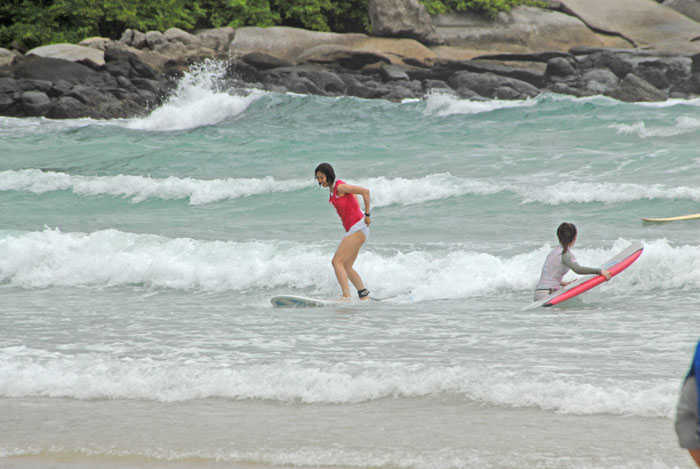
Walk out until the water is around waist deep and you are still inside the broken waves. Keep your board beside you with the nose pointing towards the incoming waves. Do not hold the board between yourself and an approaching wave, as the wave can push it back into you.
Let a few waves roll past first. Get a feel for the rhythm, how strong the whitewater is, and where the waves are pushing towards the beach. Then turn around, face the shore, get on your board and paddle before the whitewater reaches you.
- Start in waist-deep water where the broken waves are rolling in.
- Keep your surfboard beside you, with the nose pointing towards the waves.
- Turn towards the beach before the whitewater reaches you.
- Get on the board and paddle towards shore to build some speed.
- When the wave pushes you forward, stay relaxed and feel the board glide.
- Once you can ride lying down, start adding your pop-up.
Take your time with this stage. Catching whitewater waves develops timing, balance, board control and confidence. It is how all surfers learnt.
Once you can consistently catch whitewater waves, pop up smoothly, and ride into the beach keeping your surfboard in control, then you can start thinking about catching small green waves.
Read the full guide to riding your first whitewater waves
Surfing Rules and Etiquette
Learn the basics before paddling into the lineup
Before paddling out the back and catching unbroken waves, it is important to understand the basic rules of surf etiquette.
These rules help prevent collisions, injuries and damaged boards. Most surfers are understanding when someone is learning and treats others with respect. If you are unsure about something, ask an instructor or an experienced surfer before entering a busy lineup.
- Do not drop in: if someone is already riding the wave, do not take off in front of them.
- Know who has right of way: the surfer closest to the breaking part of the wave usually has priority.
- Do not snake: do not paddle around someone who has been waiting just to get closer to the peak.
- Paddle behind the surfer riding the wave: take the whitewater on the head, rather than getting in their way.
- Hold onto your board: a loose surfboard can seriously hurt someone.
- Communicate and apologise: misunderstandings happen, and a quick apology helps keep things friendly.
The main idea is to be aware of the people around you, wait your turn and keep control of your board. Everyone had to learn, and a little patience and consideration help make the surf safer and more enjoyable for everyone.
Read the full guide to surfing rules and surf etiquette
Catching Your First Green Wave
This is where timing starts to matter
After you can catch whitewater waves, pop up smoothly, and understand the basic rules of surfing, you can start thinking about catching small unbroken waves. These are often called green waves, because you are riding the clean open face before the wave has fully broken.
Everyone remembers their first green wave. It is a different feeling from riding whitewater. Instead of the broken wave pushing you straight towards the beach, you are trying to paddle into the wave early enough, feel the board lift and glide, then stand up before the wave runs away without you.

The big difference is timing. If you paddle too early, you may be too far in front of the wave. If you paddle too late, the wave will lift you, pass underneath, or pitch you over the falls. Somewhere in the middle is the sweet spot where the board starts to glide down the wave face.
When the wave approaches you, start paddling early and build speed. As the wave lifts the tail of your board, give a few strong paddle strokes. The moment the board starts to plane and slide forward, that is when you pop up. Not before, not after — easy to say, but it takes a lot of practice to get it right.
- Start with small, soft green waves, not steep dumping/pitching waves.
- Paddle early so you have speed before the wave reaches you.
- Look for the part of the wave that is steep enough to push you, but not so steep that you nose dive.
- Pop up when the board starts gliding down the face of the wave.
- You will miss some waves and occasionally nose dive. This is a normal part of learning.
There is no need to hurry into green waves. Spend as much time as you need in the whitewater. Green waves will feel more manageable once you are comfortable with paddling, positioning and standing up.
Read the full guide to catching and riding your first green wave
Getting Through Waves: Duck Dive or Turtle Roll
The right technique depends on the board you are riding
Once you start paddling out through broken waves, learning how to get through the whitewater will help you conserve energy. On a smaller surfboard, surfers usually duck dive. On a larger board or longboard, a turtle roll is normally more suitable.
A duck dive is when you push the surfboard under the wave and let the whitewater pass over you. It takes practice to learn the timing and to push the board deep enough. If the wave pushes you backwards, reset your position and try again on the next one.

For most people learning on larger boards, a turtle roll is more useful. This is where you roll the board upside down, hold the rails, and let the broken wave pass over the board while you are underneath it.
- Duck dive: best for smaller boards that can be pushed under the water.
- Turtle roll: better for longboards, soft-tops and other larger boards.
- Start the move before the wave reaches you, not after it is already on top of you.
- Hold onto your board unless letting go is the only safe option.
- Start paddling again as soon as you come through the wave.
Do not worry if this feels awkward at first. Getting through waves takes timing, practice and a bit of getting rolled around. That is all part of learning to surf.
Read the full guide to duck diving and turtle rolling
Wetsuits and Rash Guards
Choose what suits the water and keeps you comfortable
What you wear in the surf depends on the water temperature, sun, wind and how long you plan to stay in. In cold water, a wetsuit keeps you warm enough to surf properly. In warm places like Thailand, a rash guard or lycra shirt is often more useful for sun protection and stopping board wax from rubbing your skin raw.
If you do need a wetsuit, fit is the most important thing. It should feel snug, but not so tight that you cannot paddle, stretch or breathe properly. Raise your arms, bend forward, squat, and check that the suit moves with you.

For rash guards, look for something close-fitting and long enough that it does not ride up while you are paddling. Some rash guards have a small loop at the front to tie into your boardshorts, which helps stop them creeping up in the surf.
- Cold water: choose a wetsuit that fits snugly and allows easy paddling.
- Warm water: a rash guard is often enough for sun and rash protection.
- While learning: comfort and freedom of movement are the most important things.
- Used wetsuits: check seams, underarms and worn areas before buying.
A wetsuit that is too tight can restrict your paddling, while a loose rash guard may ride up. A comfortable fit allows you to concentrate on your surfing.
Read the full guide to choosing a wetsuit or rash guard
Surfboard Leashes
Wear it on your back ankle, but do not rely on it too much
A surfboard leash, or legrope as we often call it in Australia, is the cord that attaches your surfboard to your ankle. It stops your board washing all the way to the beach when you fall off.
Your leash goes on your back leg. If you surf regular foot, with your left foot forward, the leash goes on your right ankle. If you surf goofy foot, with your right foot forward, the leash goes on your left ankle.

Choose a leash that is roughly the same length as your surfboard, or slightly longer. A good-quality leash that suits your board and the waves you are surfing is all you need.
- Attach the leash to your back ankle.
- Make sure the rail saver is fitted properly to protect your board.
- Do not pull hard on the leash when your board is being held by a wave.
- Practise removing the ankle strap quickly in case it gets caught.
- Treat your board as if it is not attached — always try to hold onto it whenever you can.
A leash is a safety aid, not an excuse to throw your board around. A loose surfboard can still hit other people, and it can still come back at you if a wave grabs it.
Read the full guide to choosing and using a surfboard leash
Surf Wax and Traction Pads
A bit of grip makes standing up so much easier
Surf wax goes on the deck, or top, of the surfboard. It gives your feet and body the grip needed to stay on the board. Without wax, the deck of most surfboards is very slippery.
Most surfers use a harder base coat first, then a softer top coat over it. The top coat should bead up and feel grippy under your feet. Make sure you use wax suited to the water temperature where you are surfing. Tropical wax in cold water, can be slippery or cold-water wax in the tropics, wears off really quickly onto you.

Traction pads, also called deck grips, are usually placed near the tail of the surfboard for your back foot. They become more useful as you start turning and moving your feet, although wax on the deck is normally all you need when getting started. A traction pad can also help you feel where your back foot is on the board.
- Surf wax: the basic grip most people need when learning.
- Base coat: the harder first layer on a clean board.
- Top coat: the stickier wax you rub over the base coat.
- Traction pad: useful for the back foot, mostly on shorter boards.
- Wax comb: handy for roughing up old wax or stripping it off.
If you are learning on a soft-top or larger board, make sure there is enough grip where your chest, hands and feet will be.
Read the full guide to using surf wax and traction pads
Surfboard Fins
Fins help with direction, control and turning
Surfboard fins help your board hold direction, turn and feel more controlled on the wave. Different fin shapes and setups change how a surfboard performs, but you do not need to know all the differences when you are first learning.
The important thing to remember is that fins can be sharp and may cause cuts. Be careful when falling, walking with your board and stepping off in shallow water. Try not to ride your board all the way onto the sand, as this can damage the fins or fin box.

As you begin turning and gain more experience, you may want to learn more about how fins affect the board. For now, make sure they are fitted properly and take care not to land on them.
Read the full guide to surfboard fin selection and placement
Practise, watch other surfers, ask for advice and keep returning to the basics. Be patient with yourself and enjoy the time you spend in the water.
More Help with Learning to Surf
If you are learning in Phuket, you are welcome to join us for a lesson at Bang Tao Beach. We teach everything step by step, beginning on the beach before helping you put it into practice in the water.
👉 Learn to surf with Merrick Davis in Noosa, Australia
Want something to read between surfs? 👉 Surf books & DVDs
Essential Surf Gear for Getting Started
If you are just starting out, keep it simple. The right board, wax and leash will do more for you than a pile of fancy gear.
Really useful when you are learning to surf. Many of my friends use this to learn. Great work guys!!
My cousin would like to go on a surfing adventure because this will help her feel more relaxed and renewed. Well, I guess you are right that it will be best to learn the rules first before touching the waves. We’ll also keep in mind to invest in the correct gears.
Thanks for the tip that having a wetsuit will help a lot in making my first time surfing a lot more comfortable. I’m interested in taking surfing classes soon because I recently moved to a neighborhood that’s pretty close to the coastal area. I think it would be nice to take advantage of how close I am to the beach now.
Thanks Guys
Lots of useful information that has really helped me!
Cheers