Thai Food and Drinks
Surfing Thailand        Travel Thailand        Surf and Sports news


Thai Food and cuisine

Thai people love to eat. There is nothing that they enjoy more. Every corner, street and alley has a restaurant, street stall or stand selling snacks, nibbles, bites and full menus of tantalising local specialities.

Tourist restaurants will often serve up a spineless, tasteless version of what should be a full flavour feast, and without anyone to tell you the food is less than genuine; a visitor’s introduction to Thai food is often tainted by these ‘farang-ised’ Thai dishes. Once you have had enough of yet another overly sweet, messy slop of phad thai, it is time to explore the never-ending possibilities of Thai cuisine.

When asked what they like most about Thailand, visitors often answer ‘the food’. The creation of Siam servings is a masterful mix of salty, sweet, sour, spicy and bitter. The spice factor, often too much for most westerners, is used for medicinal purposes, combined with the use of market fresh vegetables and the choicest local herbs for bursting flavours and prevention of common ailments. The food is low in fat and high in fibre and most dishes, considering they taste so good, are surprisingly nutritious.

But it is not only the unique and pleasantly pungent tastes that visitors love, the cost of eating in Thailand is as satisfying as the pleasure experienced by the palate. One of Thailand’s major industries is agriculture. Grains, meats, vegetables and most importantly rice are all locally produced at minimal cost. The country also has rich waters filled with fresh and sea water creatures, which are shipped across the land, making seafood and fish dishes some of the most popular choices. Add to this the natural innovation and long standing techniques used by Thais in food preparation and there are few who visit who cannot be satisfied.

Thai cuisine is characterised by strong spices, especially lime juice, lemon grass and fresh coriander, the combination of which gives Thai food its distinctive taste. In addition, Thai food has a reputation for being spicy, with hot little torpedo-shaped chillies called phrik khii nuu (lit. "mouse shit chillies") making their way into many a dish. Thais are well aware that these can be more than Westerners can handle and will often ask if you like it hot; answer "yes" at your own risk!

Thai Food

Thai dishes can be roughly categorized into central Thai food (around Bangkok), northern Thai food (from the northern region around Chiang Mai, with Burmese and Chinese influence), northeastern Thai food (from the Isaan region bordering with Laos) and southern Thai food (with heavy influences from Malaysia). Read More about Thai food by region

Thailand is the only country that eats food with a spoon and fork and soup with chopsticks :-) . You will catch on to this when you are in Thailand

The cost of living varies throughout Thailand and is largely governed by the amount of tourists in the area. in general a cheap basic meal of one dish and a soft drink will cost around 40 - 150 baht. In the mid range prices are approximately 150 - 300 baht.

At the top end you could pay up to 2000 baht for a 5 star seafood buffet. If you are on a tight budget roadside stalls are a good option. Read More about Thai food by region

The following list covers some better-known central and southern dishes and other types of Thai food will be added in the future.

Learn a few Thai words and phrases

Thai Cookbook
Everything Thai Cookbook


Back to Top


Rice
The Thai staple is rice (khao), so much so that in Thai eating a meal, gin khao, literally means "eat rice".

Khao suay or "beautiful rice" is the plain white steamed rice that is the basis of almost every meal.

Khao phat is simple fried rice, usually with pork (moo) prawns (goong) or chicken (gai).

Khao tom is a rice porridge served with condiments, quite popular at breakfast.

Khao mun gai (chicken) or moo (pork) or moo daeng (red pork) is a popular dish which is steamed chicken, pork or red pork served on a special sticky rice. It is classically eaten with a medium spicy ginger and chilli condiment and steamed vegetables

Back to Top


Noodles

In addition to rice, Thais are great noodle eaters. The most common kind are rice noodles, being angel-hair (sen mii hoon), small (sen lek), large (sen yai) and giant (koy tiow), but yellow egg noodles (ba mii), Chinese-style stuffed wonton ravioli (kiaw) and glass noodles made from mung beans (wun sen) are also popular.

Unlike most Thai foods, noodles are usually eaten with chopsticks. They are also usually served with a rack of four condiments, (kueung pueung) namely dried red chillies , vinegar, fish sauce with chilli and sugar — every diner can mix them into their own liking.

Phat thai, literally "fried Thai", means thin rice noodles fried in a tamarind-based sauce. It is simple, cheap and often excellent — and as an added bonus, it's usually chili-free! But to be sure remember to say (mai phet) which means 'not spicy'.

Ca-nom gien, is the classic Thai breakfast. Thai noodles (Thai spaghetti) with a yellow fish curry sauce. Eaten with various edible leaves, raw vegetables, pineapple and boiled eggs. Very delicious medium to hot curry and very inexpensive at around 10 to 20 baht per bowl.

Bamii moo daeng is yellow egg noodles with slices of Chinese-style red pork.

Stir fried prawns
Stir fried prawns with mushrooms and garlic chive flowers

Back to Top

Soups and curries and Stir Fried
The line between soups (tom, literally just "boiled") and curries (gaeng) is a little fuzzy, and many dishes the Thais called curries would be soups to an Indian. A plate of rice with a ladleful of a curry or two on top, known as khao kaeng, is a very popular meal if eating alone.

Tom yam kung is the quintessential Thai dish, a sour soup with prawns, galangal and lemongrass. The real thing is quite spicy, but toned-down versions are often available on request. A southern Thai twist is to add coconut or cows milk making it slightly creamy and delicious.

Tom kha gai is the Thai version of chicken soup in a rich galangal-flavored coconut stock, sometimes with mushrooms and usually not very spicy.

Gaeng daeng (curry red) and gaeng phet ("hot curry") are the same dish and, as you might guess, this coconut-based dish can be spicy. Red curry with roast duck (gaeng ped yaang) or red curry with beef are particularly popular.

Gaeng khiow-waan (curry green sweet), sweet green curry, Usually milder than the red variety is a coconut-based curry with strong accents of lemongrass and kaffir lime. It is the classic Thai Green curry, a dish Thailand is famous for. Traditionally it contains either chicken or beef and small egglpants. It is considered mildly spicy, but this can range from mild to very hot, check with the restaurant you are at, they would be pleased to explain the intensity of thier curry dishes.

Gaeng som, (curry orange) is more like tamarind soup than curry, usually served with pieces of herb omelette in the soup, it is extremely strong and spicy and definitely for the chilli initiated.

Koyt diouw ruea, boat soup, is a southern Thai specialty which is a beef stew style noodle soup. It is very popular with Thai people and includes spices such as anise and cinamon. It is usually served with freshly cooked beef and simmered beef which has been cooked overnight and is very tender. This soup is mildly spicy, but the condiments which it is served with when added makes can make it very hot and spicy. It is best to strat with the original soup and add as desired.

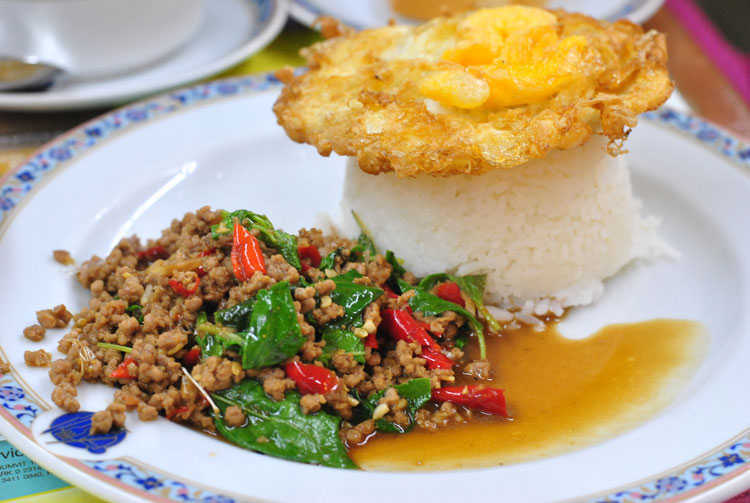
Ka-prao gai, literally "basil chicken" is a simple but intensely fragrant stir-fry made from peppery holy basil leaves, chillies and chicken.

Thais like many of their foods fried or grilled (thawt or phat) or grilled (yaang). Fish, in particular, is often deep-fried so that even the meat turns brown and crispy.

Deep fried cod with sweet chili lime sauce

Thai Cookbook
Thai regional cookbook


Back to Top


Salads
About the only thing Thai salads (yam) have in common with the Western variety is that they are both based on raw vegetables. A uniquely Thai flavor is achieved by the ingredients fish sauce, lime juice and chillies — the end result can be very spicy!

Yam som-oh is an unusual salad made from pomelo (a mutant version of grapefruit), often including chicken or dried shrimp.

Som tum, is a very popular and famous green papaya (paw paw) salad, originating from the north eastern areas of thailand. There are many different styles and versions of this salad, but basically it contains, green papaya, peanuts, lime juice, snake beans, dried shrimp, palm sugar and tomatoes, smashed and combined with a very large wooden mortar and pestle. Variations include salted and fermented black crabs and or a northern concoction of fermented fish, which is for the strong only.

There are many Thai style salads with or without noodles (usually glass noodles).


Back to Top


Vegetarian food
Vegetarians won't have too many problems surviving in Thailand, with one significant exception: fish sauce (naam plaa) is to Thai cuisine what soy sauce is to Chinese food, and keeping it out of soups, curries and stir-fries will be a challenge.

That said, Thailand is a Buddhist country and vegetarianism is a fairly well-understood concept, especially among Chinese Thais (many of whom eat only vegetarian food during several festivals).

Tofu is a traditional Thai ingredient and they aren't afraid to mix it up in some non traditional dishes such as omelettes (with or without eggs), submarine sandwiches, and burritos. Since Thai dishes are usually made to order, it's easy to ask for anything on the menu to be made without meat or fish. Bangkok features several fantastic veggie and vegan restaurants, but outside of big cities make sure to check that your idea of "veggie" matches the chef's.

Some key phrases for vegetarians:

phom gin jay (m) / di-chan gin jay (f) "I eat only vegetarian food"
karunaa mai sai naam plaa "Please don't put in fish sauce"

Information on Thailand's vegetarian festival

Thai Cookbook
The After-Work Thai Cookbook :
How to Rustle up an Exotic Supper in an
Instant with Over 65 fast, Simple and Delicious Recipes

Back to Top


Thai Desserts & Fruit

Thai desserts, in general, use five base ingredients: coconut cream, coconut flesh, rice flour, palm sugar and eggs. Among the favourites are thong yip, a sweet egg yolk cup; foi thong, shredded, sweetened egg yolk, and tako, a jelly served with creamy coconut.

There are few countries that can offer such a range of fruits like Thailand. Its tropical climate and heavy rains in monsoon season mean that fruit is everywhere. The diversity of delicious fruity sweetness to be found is so vast and the cost so little, some health conscientious rebels decide to diet solely on fruit as an internal body cleansing exercise. From the vibrant pinks of the dragon fruit to the prickly looking shells of the rambutan, photo opportunities are an added bonus to the already particular delight of fruit shopping in Thailand.

Back to Top


Water and Ice
Tap water is usually not drinkable in Thailand. Bottled water (naam plao) is cheap and inexpensive at 5-10 baht a bottle, and drinking water served in restaurants is always at least boiled (naam tom). Ice (naam kaeng) in Thailand usually comes packaged straight from the factory and is safe; there is only reason to worry if you are served hand-cut ice.

Iced drinks
Coconut water (naam ma-phrao), iced and drunk directly from a fresh coconut is a cheap and healthy way to cool the body - available at restaurants and also from vendors that specialize in fruit juice.

Fruit juices, freezes and milkshakes of all kinds are very popular with Thais and visitors alike. Most cafes and restaurants charge 20-40 baht.


Back to Top


Tea and coffee
One of Thailand's most characteristic drinks is Thai iced tea (chaa yen, "cold tea"). Instantly identifiable thanks to its orange color, this is the side effect of adding ground tamarind seed (or, these days, artificial color) during the curing process. The iced tea is always very strong and very sweet, and usually served with a dash of condensed milk; asked for chaa dum yen to skip the milk.

Naam chaa and chaa jiin are weak and full-strength Chinese teas, often served in restaurants for free. Western-style black tea is chaa rawn 'hot tea'. Coffee (kaafae) is also widely available, and is usually served with condensed milk and lots of sugar. Ask for kaafae toong to get traditional filtered "bag" coffee instead of instant.

The Starbucks phenomenon has also arrived in Thailand, but for the moment local competitors Black Canyon Coffee and S&P still have the edge in marketshare. These are the places to look for if you want that triple-moccha latte with hazelnul swirl and are willing to pay 100B for the privilege.


Back to Top


Energy drinks
Thailand is the original home of the Red Bull brand energy drink — a licensed and rebranded version of Thailand's original Krating Daeng (meaning "Red Bull"), complete with the familiar logo of two bulls charging at each other. The Thai version, however, is syrupy sweet, uncarbonated and comes packaged in medicinal-looking brown glass bottles, as the target customers are not trendy clubbers, but Thailand's working class of construction workers and bus drivers in need of a pick-me-up. Krating Daeng and its many competitors (including Shark, .357, the popular amongst locals M150 and the inevitable Karabao Daeng, "Red Buffalo") are available in any convenience stores for 10 baht a bottle.


Back to Top


Alcohol
Drinking alcohol in Thailand, is actually comparatively expensive — but still very affordable by Western standards.

Thai whisky
Thai whisky (laew) refers to a number of distilled rice liquors, the best known being the infamous Mee Khong ("Mekong") brand and its competitor Saeng Som. The only resemblances to whisky are the brown color and high alcohol content, and indeed many people liken the smell to nail polish remover, but the somewhat rum-like taste is not quite as bad, especially when diluted with cola or tonic water. This is also by far the cheapest way to get blotto, as a pocket flask of the stuff (available in any convenience store or supermarket) costs only around 50 baht.

If you want to drink the same as the locals, order laew Khao (white whiskey) or laew daeng (red whiskey) both of these are chinese and very popular. Usually mixed with M150 the health drink creating a potent mixture sure to slur your speech and put a glow on your face. Both of these whiskeys are usually only available at mini marts.

Out in the countryside many villages distil their own moonshine (laew theuan), which is strictly speaking illegal, but nobody seems to mind very much. Especially when hilltribe trekking in the North you're likely to be invited to sample some, and it's polite to at least take a sip.

mekong whiskey thai
The infamous Mee Khong Whiskey

Back to Top


Beer
Thai Beer (bia) is a bit of an upmarket drink in Thailand, with the price of a small bottle between 50 and 100 baht in most pubs, bars and restaurants, local stores charge around 35 to 80 baht for a large bottle. The largest brands are Singha (pronounced just Sing) and locally brewed Chang and Hieneken, but there is an ever-changing palette of competitors including, Kloster, Tiger and Leo.

Thais like their lagers with relatively high alcohol content (around 6%), so the beer here may pack more of a punch than you are used to.

Imported drinks
Imported liquors, wines and beers are widely available but prohibitively priced for the average Thai. A shot of any brand-name liquor is at least 100 baht, a pint of Guinness will set you back at least 200 baht and, thanks to a 340% tax, even the cheapest bottle of wine will set you back over 500 baht.

Note that, in cheaper bars (especially the go-go kind), the content of that familiar bottle of Jack Daniels may be something entirely different to what you are used too.


Back to Top

info adapted from www.wikitravel.com

http://creativecommons.org/licenses/by-sa/1.0/

Thai Food Overview

Passing through different regions of Thailand, you may notice that the dialect and sound of the language changes abruptly. When you think you have learned how to say sawdee kha in exactly the right tone, you move to another place and find that they have a completely different method of utterance. The same goes for the food. There are four main regions offering cuisine adventurers a unique experience.

Food in the northeast is influenced by neighbouring Laos. Dishes are highly seasoned and among the most popular specialities are larb, a spicy, seasoned salad made with pork or chicken; somtam, spicy papaya salad, and gai yang, barbequed chicken. All are served with glutinous rice, a northern favourite widely known as sticky rice, or khao neow.

Burmese influences have bearings on the dishes of the central northern regions. Northern cooks generally are less heavy handed with the chilli and the use of ginger, tamarind and turmeric is common. Khao soi, a curry with egg noodles and pickled cabbage, is only found in the north and should be number one on any visitor’s list of dishes to try. Tourists to the north should not miss the opportunity to dine at a traditional Khantoke dinner, combining the best of northern specialities and traditional performances in a reconstructed wooden palace.

Throughout the central plains of Thailand, the food combines mixes from all regions, and many Chinese-Thai fusions are common characteristics. The south is the place to get down to spicy treats. Chilli-filled soups and curries are common dishes and fresh seafood is abundant. Influences are also found in dishes taken from Indonesia, such as chicken kebabs with peanut sauce (gai sate), an international favourite, and rich curries such as kaeng masaman from Malaysia.

Eating in Thailand is very much a family affair. It is often thought of as odd to see someone eating alone and most Thais will wait to the point of starvation until they find a dining partner. A typical meal will include a soup, fried fish, spicy salad known as yam, a curry dish and a dip with vegetables. Each member of the party will be served a bowl of rice and can take a bite from the main dishes in the centre of the table. Meals are eaten with a spoon and fork, while chopsticks are generally only used for noodle soups or Chinese food.

Thai ‘fast food’ is known as such, not because of its enticing greasiness or fat content as with the western equivalent, but instead as a range of dishes that can be cooked up in a matter of minutes. These dishes such as phad thai, or fried noodles, khao phad, or fried rice, or phad khrapao, or fried basil with pork or chicken, are commonly ordered as a quick lunch, breakfast or evening meal, and often served with a fried egg plonked on top.

Those interested in more than just sampling the food fare on offer while travelling in Thailand will be pleased to know that in any mildly touristy area you are sure to find a local cooking school. Courses include trips to local markets, ingredient preparation, cooking and best of all, an eating party after all the hard work. Thai recipes

Top 10 Thai dishes among tourists

Tom yam goong: a spicy shrimp soup made with coconut milk, lemongrass, lime leaves, galangal and shallots.

Kaeng khio wan gai: green chicken curry made from green curry paste and coconut milk.

Phad thai: noodles fried with tofu, spring onions, bean sprouts and ground peanuts.

Phad khrapao: chicken, pork or prawns stir-fried with basil.

Kaeng phet pet yang: roast duck curry.

Tom kha gai: chicken in coconut soup with galangal and lemongrass.

Khao phad: boiled rice fried with meat, egg, onion, cilantro, garlic and tomatoes.

Moo/gai sate: pork/chicken kebabs served with peanut sauce.

Gai phad met mamuang: stir-fried chicken with cashew nuts.